Posts

A Proposal on how to save the eurozone...for now!
Image
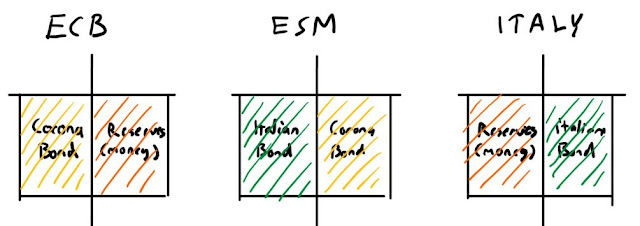
For the current crisis, the ECB had to intervene with a sizeable 750billion € Pandemic Emergency Purchase Programme (PEPP) . This program comes with a plan to buy 750 billion € worth of private and public sector securities across the yield curve (from 70day to 30year) and the purchases are to be made "flexibly", but in the long in the end according to capital keys . Also, one major feature of this program is the rule that purchases made under PEPP are not to be counted in issuer limits according to which the ECB can only hold 33% of all available government debt issuances in order to avoid being a decisive vote in a case of debt restructuring. In plain English, this means that the ECB can temporarily purchase any amount (in short term, the purchase allocation does not have to follow capital keys), within the capped 750billion € limit, of any government securities it wishes (Italian debt for example). The fact that PEPP purchases have no effect on the issuer limit is a major ...

Central Bank balance sheet and COVID19

I have been reading multiple complaints about central banks ballooning their balance sheets in order to combat COVID19-crisis, mainly from the same people who are wondering if this will lead to hyperinflation as the amount of central bank money in the system is increasing rapidly. I am going to argue that it will not and that this crisis is a best case example of a situation where central banks must increase the size of their balance sheets. In order to fight the virus, governments around the world had to resort in extreme measures, causing a full stoppage in business activity across sectors, barring people from even exiting their homes. However, as the businesses that are under forced lockdown are at the same time in need to meet their financial obligations, like rolling over their debt or paying employee salaries, some cash flow must be generated in order to avoid bankruptcy. If there is no cash flow and companies are in need to pay e.g. salaries, a new demand for debt financing...

On Helicopter Money

Image
As current emergency times call for serious action from monetary and fiscal authorities alike, a famous topic to pop up in these discussions is "cash handouts" for the people financed by central bank money creation, or more familiarly, helicopter money. Here, I will try to elaborate on why helicopter money may turn out to be a policy that will backfire into a constant need of covering ECB losses, or more gloomily, a refinancing "death-loop" that could wreak havoc throughout the whole monetary system as it is currently functioning. As a case example, and maybe here as the "most likely" one that will have to rely on some sort of helicopter drops, I will be using the European Central Bank (ECB). In a fiat monetary policy framework, short-term interest rates are either controlled mainly through reserve scarcity (a corridor system) or when reserves are abundant, through deposit rates (a floor system). Currently, the monetary policy implementation method used ...

Summary of Explaining "Not-QE"

Image
All though there are even more dynamics in play than what I have described in my previous post, I had multiple requests on making a shorter summary of it. I’ll try to keep this one as short as possible, but if you wish to have more detailed (but not detailed enough imo.) description of the core of my argument, please refer to my previous post . Here we go. Before the Global Financial Crisis (GFC), the implementation method of how the Federal Reserve (FED) implemented its monetary policy in order to attain its SHORT-TERM rate target was called a “corridor system”. This is a corridor system that came with three important factors. First, it had a roof, or the discount window , which is a “lender-of-last-resort” channel to get funding if balances at the FED are overdrawn. Second, there was a floor, which was the zero lower bound (ZLB), or Federal Funds Rate = 0% and third, and from the perspective of current issues the most important one, reserve scarcity (deposits at the FED ...

Explaining "Not-QE"

Image
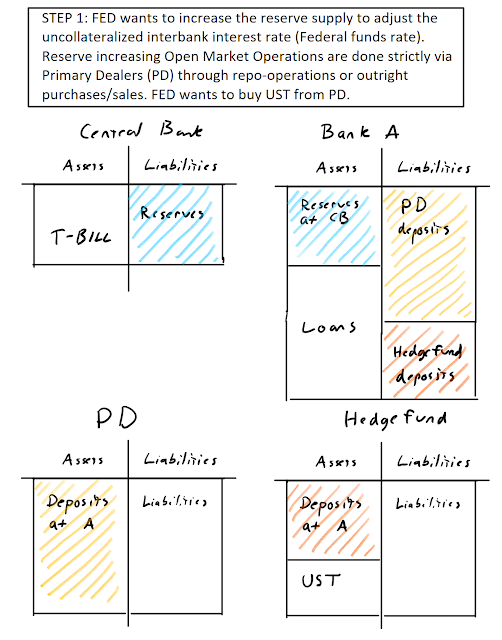
A summary of this post can be found here . As there has been a constant debate about what to make of the latest interventions by the Federal Reserve (FED), whether we can call it QE or "Not-QE",  I thought it could be appropriate to try to explain, why we can technically argue that this is not a QE . To understand this, it is essential not only to understand what the FED or any other Central Bank does but to understand how monetary policy is implemented and how it has evolved since the Global Financial Crisis (GFC) Many may know that the FED tries to control short-term rates (important emphasis on SHORT-TERM rates) by setting a Federal Funds Target Rate . The federal funds market is an interbank market where banks and other institutions trade federal funds (bank reserves) on unsecured (no collateral pledged) basis. It is important to note, that the FED only sets a target rate or a target range  and the actual prevailing rate is the weighted average of unsecured loa...